
Are you planning a trip to Bali and looking for the best temples to visit in Ubud?
I’ve spent more than three months in Bali, with a lot of that time in and around Ubud, and temples are one of the things that made this part of the island stand out to me most.
In Ubud, temples are not separated from everyday life. You pass shrines, offerings and carved gateways between cafés, homes and shops, while some of the most important temples nearby are still very much active places of worship. There are ornate candi bentar split gates, tiered meru shrines, sacred springs, rock-cut monuments and small temples hidden in river valleys, and they all feel very different from one another.
In this guide, I’m sharing the best temples in and around Ubud that I would genuinely recommend visiting, from easy stops in the town centre to sacred water temples and longer day trips that are worth the drive.
If you’re still deciding how to structure the rest of your stay, my Ubud Travel Guide covers the main areas, sights, and practical planning details around town.
Best Temples in & Around Ubud at a Glance
Not sure which temples to prioritise? Here is the quick version — what each one is best for and where it fits into your trip.
Which Ubud Temples Should You Prioritise?
You do not need to visit every temple around Ubud to get a meaningful sense of the area. In fact, trying to fit too many into one day usually makes them blur together. If this is your first visit, I would choose temples that feel genuinely different from one another rather than collecting similar stops.
If you’re building the temples into a longer stay, my 3, 5 or 7 Day Ubud Itinerary can help you work out where they fit without overloading your days.
🛕 Planning to visit several temples?
For Tirta Empul, Gunung Kawi and Mengening, a private driver is usually the easiest option. If you want to participate in purification, I would choose a guided experience instead.

If you only have time for three temples
I would choose Tirta Empul, Gunung Kawi Tampaksiring and Saraswati Temple.
Tirta Empul gives you the strongest sense of a living Balinese Hindu temple, with sacred springs and purification rituals still very much part of everyday worship.
Gunung Kawi is completely different: more archaeological, more dramatic, and much more about the landscape as you descend into the valley toward the ancient rock-cut shrines.
Saraswati Temple is the easiest one to fit into a day in central Ubud and gives you a beautiful contrast to the larger temple complexes outside town.
If you want a quieter experience
Choose Pura Mengening or Gunung Kawi Sebatu. Both are much calmer than Tirta Empul and work well if you prefer smaller temple complexes, water features, gardens and a slower atmosphere.

If you are most interested in history and archaeology
Prioritise Gunung Kawi Tampaksiring and Goa Gajah. These feel less like straightforward temple visits and more like historic sites that reveal how religion, architecture and landscape overlap in Bali.
If you want the most meaningful half-day temple route
The easiest combination is: Gunung Kawi Tampaksiring → Tirta Empul → Pura Mengening
They are close enough to make sense together without spending the entire day in the car, and each offers something different: archaeology, active ritual and a quieter sacred-spring setting.
If you want a temple as part of a longer day trip
Choose Ulun Danu Bratan. It is much farther from Ubud and makes more sense as part of a Bedugul or Munduk day rather than a standalone temple visit.
The important thing is not to treat every temple on this list as equal. Some are worth planning a route around. Others are best visited because they fit naturally into a day you are already spending nearby.

Things to Know Before Visiting Temples in Ubud
Visiting temples around Ubud is generally straightforward, but there are a few things worth knowing before you start. These are active religious sites, not just sightseeing stops, and the experience is much better when you understand the basic etiquette and don’t arrive completely unprepared.

What to Wear
For most temples, you’ll need to wear a sarong. Larger temples usually provide them at the entrance, but if you plan to visit several temples in one day, carrying your own lightweight sarong is easier.
I’d still dress reasonably modestly from the start rather than arriving in beachwear and relying on a borrowed sarong to fix everything. You’re walking into places where people may be praying, attending ceremonies or taking part in rituals, so it makes sense to dress accordingly and show respect.

Temple Etiquette
The simplest rule is to remember that these are places of worship first.
Don’t step over offerings, climb on temple structures, walk into areas that are clearly closed to visitors, or move through the middle of a ceremony just to get a better photo.
Some inner courtyards and shrines are reserved for worshippers, and that can change depending on what is happening at the temple that day. If something feels private or ceremonial, give it space.
Best Time to Visit
For the more popular temples, I would go early in the morning.
Tirta Empul, Gunung Kawi and Goa Gajah can all get much busier later in the day, and the atmosphere is noticeably different before larger groups arrive.
For quieter temples such as Mengening or Gunung Kawi Sebatu, timing matters less. I would rather build a route that makes sense geographically than rush between temples just to arrive everywhere first thing in the morning.

Entrance Fees and Cash
Entrance fees vary from temple to temple, so I’ll include the current price in each individual section instead of giving one general number here. It is also worth carrying some cash, especially if you’re visiting smaller temples or combining several stops in one day.
Purification Rituals
At water temples such as Tirta Empul, you may have the chance to take part in a melukat purification ritual.
I would not treat this as just another quick activity to add to your itinerary. If you want to participate, allow extra time and make sure you understand what you are doing rather than simply following the person in front of you.
This is one of the few situations where I think having a guide can genuinely make the experience better.


Do You Need a Guide?
For most temples, no. You can easily visit places such as Saraswati Temple, Goa Gajah, Gunung Kawi Sebatu and many of the smaller temples independently.
A guide becomes more useful when the value of the visit depends heavily on ritual, history or symbolism. Tirta Empul is the obvious example if you want to take part in purification, while Gunung Kawi becomes much more interesting once you understand what the rock-cut shrines actually represent.
If you’re visiting several temples in one day, I would also separate the idea of a guide from a driver. A driver solves the transport problem. A guide adds context. Depending on the route, you may need one, both, or neither.
Best Temples in Ubud Town
You do not have to leave Ubud to start seeing temples. Some of the easiest ones to visit are right in the centre, woven so naturally into the town that it is easy to walk past them without really noticing.
They are not the temples I would build an entire day around, but they are worth seeing because they show a different side of temple life in Ubud: smaller, more integrated into everyday streets, and much easier to combine with walking, markets, cafés and other central sights.
1. Saraswati Temple — Best for an Easy Temple Visit in Central Ubud
Saraswati Temple is one of the easiest temples to visit in Ubud, and probably the one most people notice first because of its lotus ponds.

The entrance is framed by water, stone carvings, and flowering lotus plants, with the temple sitting at the end of the path. It is compact, very central, and easy to combine with Ubud Palace or simply add to a walk through town.
What I like about Saraswati is that it does not require much planning. You do not need a driver, a route, or half a day. You can simply stop in while you are already in central Ubud.
The main visitor area is the garden and lotus pond. The inner temple is used for ceremonies and worship, so access may be limited depending on what is happening that day.

✨ Need to Know
- ⏰ Open: Daily from around 8:00 AM to 6:30 PM. Friday hours can extend later because of evening performances.
- 📍 Location: Right in central Ubud, just a few minutes’ walk from Ubud Palace and the Art Market.
- 💸 Entrance: Around IDR 65,000 for foreign adults. Sarong use is generally included with the ticket.
- 🚶 Getting there: Easiest on foot if you are staying or already exploring central Ubud.
- 🌸 Best for: Lotus ponds, ornate Balinese architecture and an easy first temple visit in town.
- 🗺️ Combine with: Ubud Palace, Ubud Art Market and a central Ubud walk.
- 💭 My take: Worth stopping for if you are already in central Ubud, but I would not make a special trip only for this temple.
- 🎭 Good to know: Traditional Balinese dance performances are held in the evening on most days, and the inner sanctuary is not generally open for casual sightseeing.
2. Ubud Palace — Best for Royal Architecture and Evening Dance
Ubud Palace sits right in the centre of town and is easy to visit alongside Saraswati Temple and the Art Market. It is technically a royal palace rather than a temple, but it belongs in this guide because it gives useful context to Ubud’s religious and cultural landscape and is one of the easiest historic sites to visit on foot.
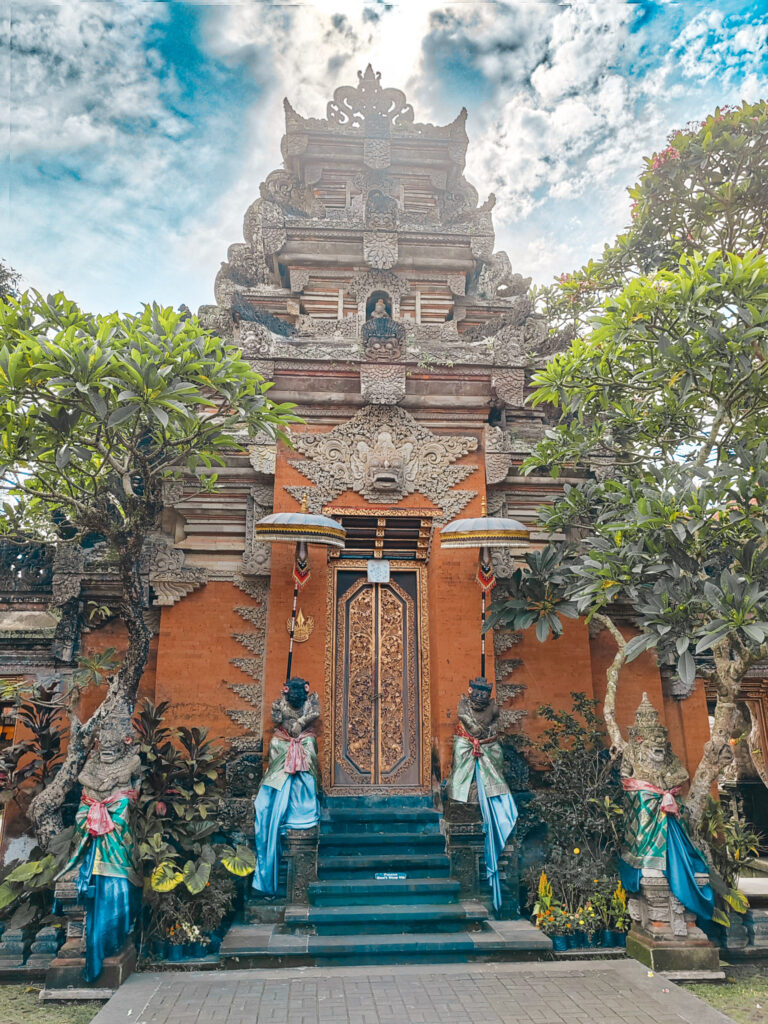
The palace is compact, with carved gateways, courtyards and traditional Balinese architecture that you can explore fairly quickly during the day, or if you are like me, explore all the beautiful details for hours. The bigger reason to come, though, is in the evening, when traditional dance performances are held in the palace courtyard.
I also came back in the evening to watch a Legong dance here, and I think that is when the palace really comes alive. The setting makes the performance feel even more special than visiting the courtyards during the day. I wrote a separate guide to watching traditional dance in Ubud if you’re deciding where to see a performance.
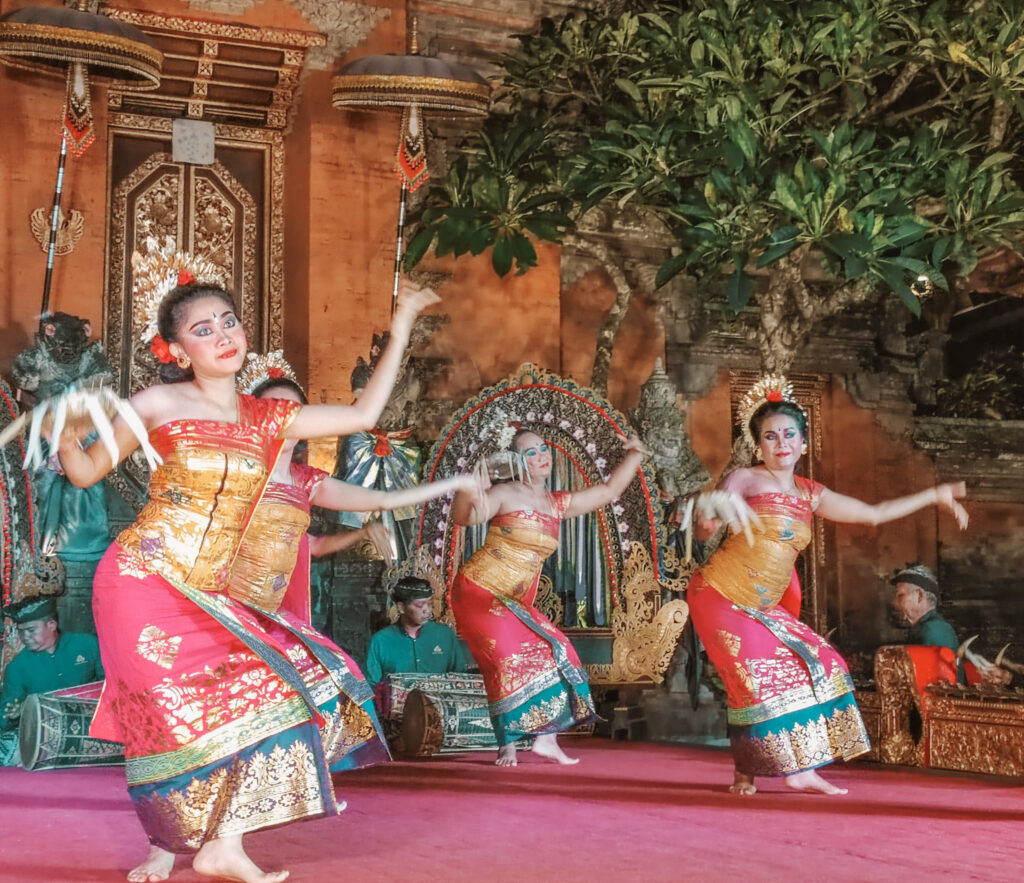
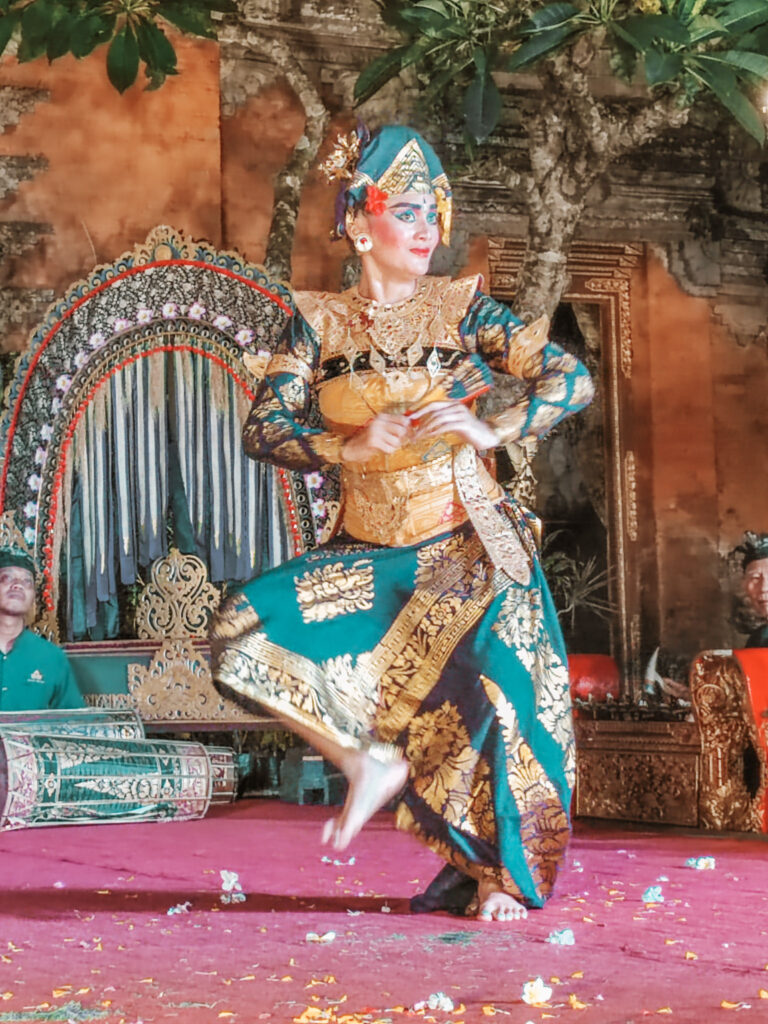
I would treat Ubud Palace as a natural stop while exploring central Ubud, rather than something to build a whole itinerary around. It works especially well if you combine it with Saraswati Temple, the market and dinner in town.
If you want to build a full day around central Ubud rather than just temple-hop, my Ubud Travel Guide has more ideas for what to combine nearby.
✨ Need to Know
- ⏰ Open: The palace grounds are generally open during the day, with evening dance performances held separately.
- 📍 Location: Right in central Ubud, opposite the Art Market and a short walk from Saraswati Temple.
- 💸 Entrance: Daytime access to the main visitor area is generally free. Evening dance performances require a separate ticket.
- 🚶 Getting there: Very easy to reach on foot if you are staying in or exploring central Ubud.
- 🏛️ Best for: Royal architecture, carved gateways and an easy cultural stop in the centre of town.
- 🗺️ Combine with: Saraswati Temple, Ubud Art Market and an evening dinner or dance performance.
- 💭 My take: Worth visiting because of its central location and cultural context, but not something I would travel across Ubud specifically to see on its own.
- 🎭 Good to know: The evening dance performances are the main reason to return after dark, and they make this a much more memorable stop than a quick daytime walk-through.
3. Pura Dalem Ubud — Best for Temple Atmosphere and Evening Performances
Pura Dalem Ubud is another easy temple to include while exploring the centre of town, but it feels quite different from Saraswati Temple or Ubud Palace.

It is a dalem temple, traditionally associated with death, cremation rites and the god Shiva in Balinese Hinduism, so the atmosphere is darker and more ceremonial than the lotus-pond setting at Saraswati. The architecture is more dramatic too, with carved stone gateways, guardian figures and dense decorative details that are easy to miss if you only pass by quickly.
During the day, access can be limited depending on ceremonies and temple activity. In the evening, the temple becomes better known for traditional Balinese dance performances, which are often the easiest way for visitors to experience the space when it is fully active.

I would not rank Pura Dalem among the temples you absolutely need to leave central Ubud for, but if you are already walking through town, it is a very worthwhile stop because it shows a much darker and more ceremonial side of Balinese temple culture.
✨ Need to Know
- ⏰ Open: Daytime access can vary depending on ceremonies and temple activity. Evening performances are held on selected nights.
- 📍 Location: In central Ubud, within easy walking distance of Ubud Palace, Saraswati Temple and the Art Market.
- 💸 Entrance: Daytime temple access may be free or donation-based when open to visitors. Evening dance performances require a separate ticket.
- 🚶 Getting there: Best visited on foot as part of a central Ubud walk.
- 🗿 Best for: Dramatic temple carvings, a more ceremonial atmosphere and traditional evening dance.
- 🗺️ Combine with: Saraswati Temple, Ubud Palace, Ubud Art Market and dinner in central Ubud.
- 💭 My take: Not a temple I would build a day around, but absolutely worth stopping at if you are already exploring central Ubud — especially if there is a dance performance that evening.
- 🎭 Good to know: Because this is an active temple, access can change without much notice when ceremonies are taking place.
4. Pura Gunung Lebah — Best for a Quiet Temple Stop Near Campuhan Ridge
Pura Gunung Lebah is one of those temples that is easy to miss even though it sits surprisingly close to central Ubud.
The temple lies at the meeting point of two rivers, just below the start of the Campuhan Ridge Walk, and the setting is what makes it special. It feels much more tucked away than the temples around Ubud Palace, with the surrounding valley, vegetation and water giving it a quieter atmosphere despite being only a short walk from the centre.


I like this one less as a “destination temple” and more as part of a wider walk. If you are already planning to do Campuhan Ridge, it makes sense to stop here on the way. On its own, I would not prioritise it over Tirta Empul, Gunung Kawi or Goa Gajah.
✨ Need to Know
- ⏰ Open: Access can vary depending on ceremonies and temple activity.
- 📍 Location: About 1 km from central Ubud, beside the start of the Campuhan Ridge Walk.
- 💸 Entrance: There is generally no major entrance fee, though donations may be appreciated.
- 🚶 Getting there: Easy to reach on foot from central Ubud.
- 🌿 Best for: A peaceful temple atmosphere, river-valley setting and an easy stop before Campuhan Ridge.
- 🗺️ Combine with: Campuhan Ridge Walk, central Ubud and nearby cafés.
- 💭 My take: Worth visiting if you are already heading toward Campuhan Ridge, but I would not make a separate trip only for this temple.
- 🙏 Good to know: This is an active temple, so some areas may be closed to visitors during ceremonies or prayer.
Best Temples Around Ubud
Once you leave the centre of Ubud, the temples become much more interesting. Several of the most worthwhile ones sit around Tampaksiring, roughly 15 km north-east of town, which makes it easy to combine two or three into a half-day trip without spending most of the day driving.
5. Tirta Empul — Best for Sacred Springs and Purification
Tirta Empul is probably the best-known temple near Ubud, and also one of the few where I think the experience goes well beyond simply looking at the architecture.
The temple was built around a natural spring whose water is considered sacred in Balinese Hinduism. The purification pools are the part most visitors recognise: long stone pools lined with fountains, where worshippers move through the water as part of the melukat purification ritual.

I loved Tirta Empul, particularly watching the purification ritual in the pools. There were a lot of people taking part when I visited, though, and I decided not to join the purification myself this time. I was happier observing it properly rather than squeezing into the pools just because I felt I could.
If purification is something you genuinely want to experience, I would give it proper time rather than treating it as another stop on a temple tour. You need time to change, understand the ritual, move through the fountains, and then explore the temple afterwards.
I would also make sure to continue beyond the purification area. It is easy to focus entirely on the water and leave without properly exploring the rest of the temple complex, where the courtyards, shrines, and sacred spring itself give much more context to what is happening in the pools.


If you are only visiting the temple, you can easily do it independently. If you want to take part in melukat and actually understand the meaning behind what you are doing, this is one of the places where I think having a knowledgeable guide makes sense.
✨ Need to Know
- ⏰ Open: Daily from around 8:00 AM to 6:00 PM. Go early if you want to experience the temple before the main tour groups arrive.
- 📍 Location: In Tampaksiring, about 15–16 km from central Ubud.
- 💸 Entrance: Around IDR 75,000 for foreign adults. A sarong for entering the temple is normally provided.
- 🚗 Getting there: Easiest by scooter, private driver or as part of a temple tour from Ubud.
- 💧 Best for: Sacred springs, Balinese Hindu ritual and experiencing a temple that is still very actively used for worship.
- 🗺️ Combine with: Gunung Kawi Tampaksiring and Pura Mengening — all three are close enough to make an excellent half-day temple route.
- 💭 My take: One of the temples near Ubud I would genuinely prioritise, especially if this is your first trip to Bali. The crowds can be noticeable, but the religious life of the temple makes it worth visiting.
- 🙏 Good to know: If you want to take part in the melukat purification ritual, plan considerably more time than for a normal temple visit. The sarong used for entering the temple is not necessarily the same clothing used inside the purification pools, so follow the instructions at the temple.
6. Gunung Kawi Tampaksiring — Best for Ancient Rock-Cut Shrines and Landscape
Gunung Kawi is one of the temples near Ubud where the setting matters almost as much as the site itself.

You reach it by descending into the Pakerisan Valley, passing rice terraces and dense greenery before arriving at a series of enormous shrines carved directly into the rock. That approach is a big part of what makes the place memorable. It does not feel like stepping out of a car, looking at a temple and moving on.
The rock-cut monuments, known as candi, are the main reason people come, but the wider complex is worth exploring too. There are temple courtyards, river views and pathways through the valley, and the whole site feels much more atmospheric than a quick roadside stop.
The climb back up is the part to keep in mind. It is not difficult if you are reasonably mobile, but there are a lot of steps, so I would avoid treating Gunung Kawi as something to squeeze into a rushed itinerary.

I also think this is one of the best temples to combine with Tirta Empul because the two experiences are so different. Tirta Empul is active, ritual-focused and centred around sacred water. Gunung Kawi feels older, quieter and much more archaeological.
✨ Need to Know
- ⏰ Open: Daily, generally from morning until late afternoon. Earlier visits are more comfortable and usually quieter.
- 📍 Location: In Tampaksiring, about 14–15 km from central Ubud.
- 💸 Entrance: Around IDR 50,000 for foreign adults. Sarong use is generally included.
- 🚗 Getting there: Easiest by scooter or private driver. It also fits naturally into a half-day temple route from Ubud.
- 🗿 Best for: Ancient rock-cut shrines, archaeology, river-valley scenery and one of the most atmospheric temple approaches near Ubud.
- 🗺️ Combine with: Tirta Empul and Pura Mengening.
- 💭 My take: One of the temples near Ubud I would prioritise most. The setting makes it feel completely different from the more formal temple complexes around Bali.
- 🥾 Good to know: Expect a substantial number of steps down into the valley and back up again. Wear comfortable shoes and do not plan this as a five-minute stop.
7. Pura Mengening — Best for a Quieter Sacred-Spring Temple
Pura Mengening sits very close to Tirta Empul, but the experience feels noticeably different.
It is another sacred water temple, with spring-fed pools and purification areas, yet it is usually much quieter and more intimate. If Tirta Empul feels busy or overwhelming, Mengening is the place I would look at instead.


The temple is built around a series of pools and stone steps, with water flowing through the complex in a way that makes the whole place feel very calm. It is still an active religious site, but there is less sense of moving through a major tourist attraction and more of simply being allowed into a sacred place that happens to welcome visitors.
I would not necessarily choose Mengening instead of Tirta Empul on a first visit to Bali, because Tirta Empul has more historical and ritual importance. But if you are already visiting the Tampaksiring area, Mengening adds a completely different atmosphere without requiring much extra travel.
✨ Need to Know
- ⏰ Open: Daily during daytime hours. Mornings are usually the most peaceful.
- 📍 Location: Near Tampaksiring, about 15 km from central Ubud and only a short drive from Tirta Empul.
- 💸 Entrance: Usually a small entrance fee or donation is expected. Sarong rules apply.
- 🚗 Getting there: Easiest by scooter or private driver, especially if you are already visiting Tirta Empul or Gunung Kawi.
- 💧 Best for: Sacred springs, a quieter purification setting and a calmer alternative to Tirta Empul.
- 🗺️ Combine with: Tirta Empul and Gunung Kawi Tampaksiring.
- 💭 My take: I would not replace Tirta Empul with Mengening on a first visit, but I would absolutely add it if you want a quieter and more intimate water-temple experience.
- 🙏 Good to know: Purification rituals also take place here, but the atmosphere is generally much less busy than at Tirta Empul. Follow local instructions and do not enter ritual areas casually.
8. Gunung Kawi Sebatu — Best for a Peaceful Water Temple and Gardens
Gunung Kawi Sebatu is one of the quieter temples near Ubud and a good choice if you want something more peaceful than Tirta Empul without losing the water-temple atmosphere.


Despite the similar name, this is not the same place as Gunung Kawi Tampaksiring. Gunung Kawi Sebatu is a smaller temple complex built around spring-fed pools, gardens and water features, with a much softer and more intimate feel than the dramatic rock-cut shrines at Tampaksiring.
It works especially well if you are already visiting Tegallalang, because the two are close enough to combine without turning the day into a long drive. I would also choose it over another major temple if you are starting to feel “templed out” and want somewhere slower and greener.
✨ Need to Know
- ⏰ Open: Daily during daytime hours. Earlier visits are usually quieter and cooler.
- 📍 Location: In Sebatu, north-east of Ubud, about 12–15 km from central Ubud.
- 💸 Entrance: Usually a modest entrance fee. Sarong rules apply.
- 🚗 Getting there: Easiest by scooter or private driver, especially if you are combining it with Tegallalang or other stops north of Ubud.
- 🌿 Best for: Spring-fed pools, gardens, water features and a quieter temple atmosphere.
- 🗺️ Combine with: Tegallalang Rice Terraces, nearby cafés and other stops north of Ubud.
- 💭 My take: A lovely choice if you want a peaceful temple experience and do not feel like visiting another busy, major complex.
- 💧 Good to know: Do not confuse it with Gunung Kawi Tampaksiring — the two are completely different temple experiences.
9. Goa Gajah — Best for Archaeology, Carvings and a Jungle Setting
Goa Gajah feels very different from the water temples around Tampaksiring.

The famous cave entrance is the part everyone recognises first, with its dramatic carved stone face framing the doorway, but the site is much more than that one photo. There are bathing pools, temple remains, stone steps and paths leading down into a greener, quieter part of the complex.
That is the part I would not rush. It is easy to arrive, see the cave, take a photo and leave, but the lower section is what makes the visit feel more complete.

Because Goa Gajah is so close to Ubud, it is one of the easiest temples to add to a half-day without committing to a longer drive. It also works well if you are already heading east of town.
✨ Need to Know
- ⏰ Open: Daily during daytime hours. Earlier is better if you want a quieter visit.
- 📍 Location: About 4–5 km east of central Ubud, making it one of the easiest major temples to reach from town.
- 💸 Entrance: A standard entrance fee applies, and sarong rules are usually in place.
- 🚗 Getting there: Easy by scooter, Grab, private driver or as part of a wider east-Ubud route.
- 🗿 Best for: Archaeology, stone carvings, bathing pools and a temple site that feels much larger than the famous cave entrance suggests.
- 🗺️ Combine with: East Ubud, nearby waterfalls or other stops outside the town centre.
- 💭 My take: Worth visiting, especially because it is so close to Ubud. Just do not treat it as a quick photo stop — the lower part of the site is what makes the visit more interesting.
- 🌿 Good to know: The paths and steps continue beyond the cave and bathing pools, so wear comfortable shoes if you want to explore properly.
Temples Worth a Longer Day Trip From Ubud
Some temples make sense as quick stops from Ubud. Others do not.
Ulun Danu Bratan belongs in the second group. It is far enough away that I would never visit it as a standalone temple trip from Ubud, but it works beautifully as part of a full day through Bedugul and Munduk.
10. Ulun Danu Bratan — Best for an Iconic Lake Temple and Scenic Day Trip
Ulun Danu Bratan is one of Bali’s most recognisable temples, sitting on the edge of Lake Bratan in the cooler highlands of Bedugul.

The image everyone knows is the small multi-tiered shrine seemingly floating on the lake, especially when the water is high, and the mountains behind it disappear into mist. The setting is very different from the warmer, more enclosed temple complexes around Ubud, and that contrast is a big part of why I think it is worth seeing.
Ulun Danu Bratan was also one of those places where the visit became memorable for reasons that had very little to do with the temple itself. There were several school groups visiting from Java when I was there, and students kept coming over asking to take photos with us. We ended up posing for photo after photo and were genuinely happy to do it. In the end it became one of those random travel moments that sticks with you long after you forget another viewpoint or temple courtyard.


What I would not do is drive almost 50 kilometres from Ubud just to visit the temple and then turn around.
Ulun Danu makes far more sense as one stop in a longer route through central Bali. Pair it with Bedugul, viewpoints around the lakes, waterfalls, or Munduk, and suddenly the journey becomes part of the day rather than an inconvenient commute to one temple.
It is also one of the more polished and visitor-oriented temple complexes in Bali, so the experience is different from smaller working temples such as Mengening. Come for the setting, architecture, and landscape rather than expecting the same intimate religious atmosphere.
✨ Need to Know
- ⏰ Open: Daily during daytime hours. Morning is usually the nicest time for cooler weather and softer light around the lake.
- 📍 Location: In Bedugul, about 47 km from central Ubud.
- 💸 Entrance: A standard entrance fee applies. This is one of Bali’s more developed visitor sites, with ticketing at the entrance.
- 🚗 Getting there: Best reached by private driver, scooter if you are confident on longer mountain roads, or as part of a full-day tour through Bedugul and Munduk.
- 🏞️ Best for: Lake views, iconic Balinese temple architecture and a scenic highland day trip.
- 🗺️ Combine with: Bedugul, Lake Buyan and Lake Tamblingan viewpoints, Munduk and nearby waterfalls.
- 💭 My take: Absolutely worth visiting if you are already exploring central Bali, but I would not make the long drive from Ubud for this temple alone.
- 🌦️ Good to know: The weather here can be much cooler and wetter than Ubud, so bring a light layer or rain jacket even if the morning starts sunny.
11. Pura Ulun Danu Tamblingan — Best for a Quieter Lake Temple Near Munduk
If Ulun Danu Bratan is Bali’s famous lake temple, Tamblingan is the quieter, more atmospheric counterpart, and my personal favourite.

Set beside Lake Tamblingan in the Munduk highlands, the temple feels much more remote and far less polished for tourism. The surrounding forest and lake are part of the experience, which is why I would visit it as part of a broader Bedugul–Munduk day rather than make the long drive from Ubud only for the temple itself.
After visiting the temple, I stopped at a tiny local place right beside Lake Tamblingan, next to the temple, with our driver, who over time had also become a friend. We sat down for simple local food, and that whole part of the day, the quiet lake, the temple, and eating there afterwards is probably why Tamblingan stayed with me more than some of Bali’s much more famous temples.


This temple makes especially good sense if you are already visiting Ulun Danu Beratan. The two are roughly half an hour apart but feel completely different: Bratan is iconic and highly developed, while Tamblingan feels quieter, more natural and much more connected to the landscape around it.
✨ Need to Know
- 📍 Location: Beside Lake Tamblingan in the Munduk highlands, roughly 30 minutes from Ulun Danu Bratan.
- 🚗 Getting there: Best reached by private driver or scooter as part of a Bedugul–Munduk day trip.
- 🌿 Best for: A quieter lake-temple setting, forest scenery and a more atmospheric stop away from Bali’s busiest temple sites.
- 🗺️ Combine with: Ulun Danu Bratan, Lake Buyan viewpoints, Munduk and nearby waterfalls.
- 💭 My take: This is my personal favourite temple on this list. I love it for the setting as much as the temple itself: the lake, forest and quieter atmosphere make it feel much more special to me than the busier, more polished temple complexes.
- 🌦️ Good to know: The highlands are cooler and wetter than Ubud, and mist or rain can change the atmosphere quickly.
12. Besakih Temple — Best for Bali’s Largest and Most Important Temple Complex
Besakih is on a completely different scale from the smaller temples around Ubud.

Known as Bali’s Mother Temple, it is the largest temple complex on the island, spread across the slopes of Mount Agung and made up of multiple individual temples rather than one single sanctuary.
The setting is one of the biggest reasons to go. On a clear day, the mountain rises behind the temple complex and gives the whole place a much more dramatic sense of scale than anything you’ll find in central Ubud.


I would not treat Besakih as a quick temple stop. It works best as part of a longer east Bali day, especially if you are already combining it with viewpoints, Sidemen or other stops in the area.
Because the complex is large and culturally significant, this is also one of the temples where having someone explain what you are seeing can genuinely add value rather than just slow you down.
✨ Need to Know
- ⏰ Open: Daily during daytime hours. Earlier visits are usually more comfortable and give you a better chance of clearer mountain views.
- 📍 Location: On the slopes of Mount Agung in east Bali, roughly 50–55 km from central Ubud.
- 💸 Entrance: Besakih has a higher entrance fee than most smaller temples in Bali, and visitor access is managed through the main entrance area.
- 🚗 Getting there: Best reached by private driver or as part of a full-day east Bali tour. I would not choose it as a standalone out-and-back trip from Ubud.
- ⛰️ Best for: Scale, religious significance, mountain scenery and seeing Bali’s largest temple complex.
- 🗺️ Combine with: Sidemen, east Bali viewpoints, Tirta Gangga or other stops in the Mount Agung area.
- 💭 My take: Worth the journey if you are already planning a day in east Bali, but I would not choose Besakih over Tirta Empul or Gunung Kawi if you only have one short temple outing from Ubud.
- 🙏 Good to know: The complex is large and culturally important, so a guide can be genuinely useful here if you want to understand more than the architecture and views.
Best Temple Routes From Ubud
If you want to see more than one temple in a day, the easiest way to avoid wasting hours in traffic is to group them by area. Bali can look deceptively compact on a map, but distances take longer than expected, especially once you start moving through smaller roads outside Ubud.
I would not try to visit six or seven temples in one day. Two or three well-chosen temples, with time to actually explore them, is a much better experience.
Map of the Best Temples in & Around Ubud
To make planning easier, I’ve mapped all the temples in this guide below. The colours roughly group them into central Ubud, temples around Tampaksiring and the longer day-trip temples, so you can quickly see which ones make sense to combine.
Tip: Distances in Bali can look short on the map, but driving times are often much longer than expected, especially around Ubud. Grouping temples by area will save you a lot of unnecessary backtracking.
Half-Day Temple Route: Tampaksiring
Gunung Kawi Tampaksiring → Tirta Empul → Pura Mengening. This is the temple route I would recommend most for a first visit to Ubud.

The three temples are close together, but they feel completely different. Gunung Kawi gives you the archaeology and valley setting, Tirta Empul is the strongest place to experience a living purification tradition, and Mengening finishes the route on a much quieter note.
I would start at Gunung Kawi before the day gets hotter, then continue to Tirta Empul. If you want to take part in purification, this is where the route can easily stretch beyond half a day, which is completely fine. Finish at Mengening if you still feel like another temple rather than adding something simply because it is nearby.
💡 Insider Tips — Tampaksiring Temple Route
- 🌿 Best for: First-time visitors who want history, ritual and three very different temple experiences in one route.
- 🚗 Getting around: Scooter or private driver. A driver is the easiest option if you want to move between the temples without thinking about parking or navigation.
- 💭 My take: Probably the best temple route from Ubud if you only want to dedicate half a day to temples.
Easy Central Ubud Temple Walk
Saraswati Temple → Ubud Palace → Pura Dalem Ubud → Pura Gunung Lebah. You can do this route entirely on foot and fit it naturally around everything else you are already doing in central Ubud.

Start with Saraswati Temple, continue to Ubud Palace and the Art Market, then walk toward Pura Dalem Ubud. Pura Gunung Lebah works best at the end if you are also planning to continue onto the Campuhan Ridge Walk. If you want to turn this into a fuller central-Ubud day, you can also combine the route with the Sacred Monkey Forest, the market or one of the best spas in Ubud.
None of these temples requires a special journey on its own, which is exactly why they work so well together.
💡 Insider Tips — Central Ubud Temple Walk
- 🚶 Best for: A relaxed day in Ubud where you want to see several temples without hiring transport.
- 👣 Getting around: Walk. These stops fit naturally into a central Ubud day.
- 💭 My take: The easiest way to include temples without turning the whole day into temple hopping.
Half-Day North of Ubud: Temple + Rice Terraces
Gunung Kawi Sebatu → Tegallalang Rice Terraces. This is a much simpler route, but one I like because it mixes a temple with landscape rather than stacking several similar stops together.

Visit Gunung Kawi Sebatu first for the gardens and spring-fed pools, then continue toward Tegallalang. If you are already planning to see the rice terraces, adding Sebatu makes much more sense than travelling there as a standalone temple visit.
💡 Insider Tips — North of Ubud
- 🌾 Best for: Quieter temples, rice terraces and a slower half-day north of Ubud.
- 🚗 Getting around: Scooter or private driver.
- 💭 My take: A good alternative if you have already seen Tirta Empul or simply want something calmer.
Full-Day Bedugul & Munduk Temple Route
Ulun Danu Bratan → Pura Ulun Danu Tamblingan → Munduk. This is less a temple-hopping route and more a full highlands day with two very different lake temples.

Start at Ulun Danu Bratan, then continue toward Lake Tamblingan and my personal favourite, Pura Ulun Danu Tamblingan. From there, continue into Munduk rather than turning straight back toward Ubud.
You can add viewpoints, one waterfall, or a slower stop in Munduk depending on how much you want to fit in. I would resist the urge to cram three waterfalls, both temples and every viewpoint into the same day.
💡 Insider Tips — Bedugul & Munduk
- 🏞️ Best for: Lake scenery, cooler highlands and combining temples with Munduk.
- 🚗 Getting around: Private driver is the easiest option for this longer route.
- 💭 My take: One of the most beautiful full-day routes from Ubud, especially if you prefer landscape and atmosphere over ticking off famous sights.
Full-Day East Bali Temple Route
Besakih Temple → Sidemen / East Bali
Besakih is far enough from Ubud that I would build the rest of the day around east Bali rather than drive there only for the temple.
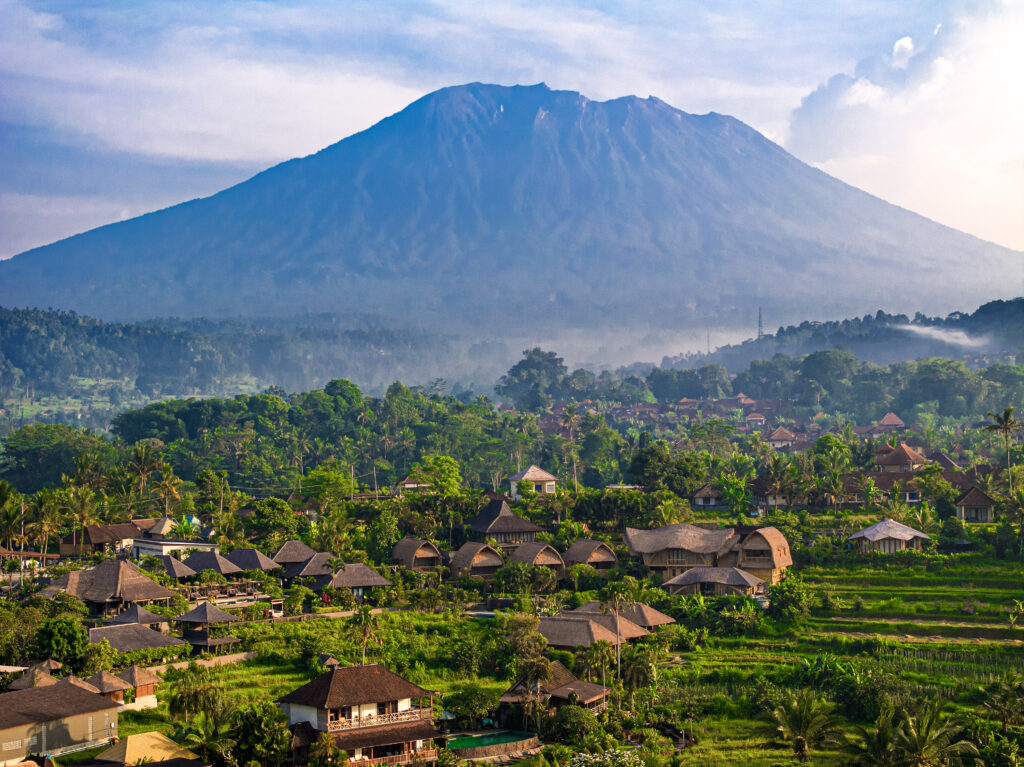
After visiting Besakih, continue toward Sidemen or add one or two east Bali stops depending on your route. The point is to make the drive worthwhile rather than treating Besakih as an isolated out-and-back excursion.
💡 Insider Tips — East Bali Temple Route
- ⛰️ Best for: Bali’s largest temple complex, Mount Agung scenery and a longer east Bali day.
- 🚗 Getting around: Private driver or organised tour.
- 💭 My take: Worth doing if east Bali already interests you; not the route I would choose if you only have a few days in Ubud.
How to Get Around the Temples Near Ubud
The temples closest to central Ubud are easy enough to visit on foot, but once you start heading toward Tampaksiring, Sebatu, Bedugul or east Bali, transport becomes part of the planning.
The best option depends less on the distance itself and more on how many stops you want to make, how confident you are on Bali’s roads, and whether you want cultural context or simply someone to handle the driving.
Scooter
A scooter gives you the most flexibility and is often the easiest way to visit two or three temples without waiting around.
It works especially well for shorter routes such as Tirta Empul + Gunung Kawi + Mengening or Gunung Kawi Sebatu + Tegallalang.
I would only choose this if you are already confident riding in Bali. Traffic around Ubud can be chaotic, and longer routes into Bedugul or east Bali are very different from a short ride around town.
Private Driver
For most temple routes outside central Ubud, this is the option I would choose.
A private driver lets you build your own route, stop where you want, and avoid having to think about parking or navigating between temples. It is especially useful if you are combining temples with rice terraces, waterfalls, viewpoints, or Munduk.
This is also the best option for longer days such as Ulun Danu Bratan + Tamblingan + Munduk or Besakih + east Bali.
Organized Tour
A tour makes the most sense when you want more than transport.
For places such as Tirta Empul, Gunung Kawi or Besakih, having someone explain the ritual, history and symbolism can add a lot more value than simply being driven from one temple to another.
I would choose a tour if you want cultural context and do not want to organize the route yourself.
Grab or Gojek
For single stops close to Ubud, Grab or Gojek can work well.
I would not rely on them for a full temple-hopping day, especially once you move farther outside town. Getting a ride out is usually easier than finding one back to Ubud from a quieter temple area.
Walking
For the central temples, walking is by far the easiest option.
Saraswati Temple, Ubud Palace, Pura Dalem Ubud and Pura Gunung Lebah can all fit naturally into a day spent exploring central Ubud, without needing any transport at all.
The main thing I would avoid is choosing transport first and then building the day around it. Decide which temples you actually want to see, group them by area, and then choose the transport that makes that route easiest.
If you’re still deciding how many days to spend in Ubud before choosing which temple routes to add, my 3, 5 or 7 Day Ubud Itinerary breaks that down in much more detail.
Best Temple Tours and Private Driver Routes From Ubud
You can visit most of the temples in this guide independently, but once you start combining several temples, or travelling as far as Bedugul, Munduk or Besakih, a private driver or guided tour can make the day much easier.
I would choose based on how much flexibility you want and how much context you want along the way.
A private driver is best if you already know which places you want to see and simply want someone to handle the roads, parking, and logistics. On the other hand, a guided temple tour makes more sense if you want to understand the rituals, history, and symbolism rather than simply move between stops.
Best First-Time Temple Route From Ubud
Goa Gajah → Gunung Kawi Tampaksiring → Tirta Empul
Best for: first-time visitors who want several genuinely different temples without spending the day in traffic.
Check Private Temple Tours From Ubud →This is probably the strongest first-time temple route from Ubud because each stop gives you something completely different.
Start at Goa Gajah for the cave, bathing pools and archaeological setting, continue to Gunung Kawi Tampaksiring for the rock-cut shrines and valley, then finish at Tirta Empul for sacred springs and purification rituals.
For this route, I would either book a private driver and explore independently or choose a guided temple tour if cultural context is important to you.

Best Private Driver Route: Temples + Tegallalang
Gunung Kawi Sebatu → Tegallalang Rice Terraces → Tirta Empul
Best for: travellers who want a mix of culture and scenery rather than temple after temple.
Book a Private Driver From Ubud →This is the best choice if you do not want an entire day devoted to temples. Gunung Kawi Sebatu gives you a quieter water temple, Tegallalang breaks up the day with rice terraces, and Tirta Empul adds one of the most important temple experiences around Ubud.
A customizable private driver is ideal here because you can adjust the route depending on crowds, weather and how long you want to stay at each stop.

Best Guided Experience: Tirta Empul Purification
If taking part in melukat purification is one of the main reasons you want to visit Tirta Empul, I would choose a guided experience rather than treating it as another sightseeing stop. You can visit the temple independently, but a knowledgeable guide can explain the ritual, the meaning of the different areas and how purification is traditionally carried out.
For me, this is one of the few temple experiences around Ubud where paying for cultural guidance can genuinely change the quality of the visit.
Best for: travellers who want to participate in purification rather than simply observe it.
See Guided Tirta Empul Purification Experiences →Best Full-Day Highlands Route
Ulun Danu Bratan → Pura Ulun Danu Tamblingan → Munduk
Best for: lake temples, mountain scenery and travellers who want a slower full-day trip north of Ubud.
Check Private Drivers for Bedugul & Munduk →This is the route I would choose if you want to turn temple visiting into a full day in Bali’s cooler highlands.
Start with the famous Ulun Danu Bratan, then continue toward Lake Tamblingan and my personal favourite temple in this guide, Pura Ulun Danu Tamblingan. From there, continue into Munduk for a viewpoint, waterfall or simply some time in the mountains.
For this route I would choose a private driver rather than a fixed group tour. The distances are longer and the day works much better when you can adapt it to the weather and spend more time somewhere you particularly like.

Best East Bali Temple Route
Besakih Temple → Gates of Heaven
If you want to turn Besakih into a full East Bali temple day, pairing it with the Gates of Heaven at Lempuyang Temple makes much more sense than driving all the way out there for just one stop.
Besakih gives you Bali’s largest and most important temple complex on the slopes of Mount Agung, while Lempuyang gives you one of the island’s most recognisable temple settings.
It is a long day from Ubud, so I would keep the route simple rather than cram in extra stops.
Best for: travellers who want two of East Bali’s most famous temple experiences in one full-day trip.
See Besakih Temple & Gates of Heaven Tours →Which Option Would I Choose?
If I were planning a first temple day from Ubud, I would choose a private driver for Gunung Kawi, Tirta Empul and Mengening.
If purification at Tirta Empul was the main reason for going, I would choose a guided experience instead.
For Bedugul, Munduk or Besakih, I would almost always choose a private driver, simply because the distances are longer and having control over the pace makes a big difference.
💡 Which Option Is Best for You?
- 🛕 First temple day: Private driver for Gunung Kawi + Tirta Empul + Mengening.
- 💧 Purification: Choose a guided Tirta Empul experience.
- 🌾 Temples + rice terraces: Book a customizable private driver.
- 🏞️ Bedugul + Munduk: Private driver for maximum flexibility.
- ⛰️ Besakih + East Bali: Private driver, with a guide at Besakih if you want more cultural context.
These are the best temples in and around Ubud that I would genuinely recommend adding to your trip.
You do not need to visit all of them. Pick the ones that fit your route, go early when you can, and give yourself enough time to actually enjoy them rather than rushing from one temple to the next.
If you’re still planning your time in Ubud, you might also find my Ubud Travel Guide, 3, 5 or 7 Day Ubud Itinerary, Where to Stay in Ubud, Sacred Monkey Forest Guide, and Best Spas in Ubud useful.
And for the rest of your trip, head to my Bali Travel Guide for more ideas on what to see, where to go and how to plan your route around the island.

Frequently Asked Questions About Temples in Ubud
What is the best temple in Ubud?
If this is your first visit, I would prioritise Tirta Empul and Gunung Kawi Tampaksiring. They are close enough to visit together but offer completely different experiences: sacred springs and active ritual at Tirta Empul, and ancient rock-cut shrines in a river valley at Gunung Kawi.
Which temples are actually in central Ubud?
The easiest temples and cultural sites to visit on foot are Saraswati Temple, Pura Dalem Ubud, Pura Gunung Lebah and Ubud Palace. Ubud Palace is technically a royal palace rather than a temple, but it fits naturally into the same central-Ubud route.
Is Tirta Empul worth visiting?
Yes, especially if you want to see a temple that is still actively used for worship and purification. It can get busy, but the sacred springs and melukat ritual make it one of the most meaningful temple experiences near Ubud.
Tirta Empul or Pura Mengening?
For a first visit, I would choose Tirta Empul because of its scale, history and importance. If you prefer quieter places or have already visited Tirta Empul, Pura Mengening offers a calmer and more intimate experience around sacred water.
What is the difference between Gunung Kawi Tampaksiring and Gunung Kawi Sebatu?
They are two completely different places. Gunung Kawi Tampaksiring is the archaeological complex with large rock-cut shrines in the Pakerisan Valley, while Gunung Kawi Sebatu is a smaller water temple with gardens and spring-fed pools.
Can you visit Tirta Empul and Gunung Kawi on the same day?
Yes. In fact, they are one of the easiest temple combinations from Ubud. I would pair Gunung Kawi Tampaksiring + Tirta Empul + Pura Mengening for a half-day route, allowing extra time if you plan to take part in purification at Tirta Empul.
Do I need a sarong to visit temples in Ubud?
Usually, yes. Most larger temples provide a sarong and sash at the entrance, but carrying your own lightweight sarong is useful if you plan to visit several temples or smaller religious sites in one day.
Do I need a guide for Ubud temples?
Not for most temples. You can visit places like Saraswati Temple, Goa Gajah and Gunung Kawi Sebatu independently. A guide is more useful at places where ritual or historical context matters, especially Tirta Empul, Gunung Kawi Tampaksiring and Besakih.
Can you visit Ubud temples without a scooter?
Absolutely. The central temples are easy to visit on foot, while temples outside town are easiest with a private driver or organized tour. For most visitors, a private driver is the most flexible option for combining several temples in one day.
What are the best temples for a half-day trip from Ubud?
My first choice would be Gunung Kawi Tampaksiring, Tirta Empul and Pura Mengening. They are close together, easy to combine, and give you three very different temple experiences without turning the day into a long drive.


