
The strange thing about Diyaluma is that the waterfall you come to see is only part of the reason to go.
From the road below, Diyaluma is all about scale: a long white column of water falling from a cliff more than 200 metres above you. I stopped there first, looking up at the waterfall I was about to somehow end up on top of.
An hour or so later, the view was completely different.
Up there, there is no single dramatic waterfall in front of you. Instead, the river runs through the forest in a series of small cascades and clear natural pools, slipping over smooth rock before eventually reaching the enormous drop I’d been looking at from below.
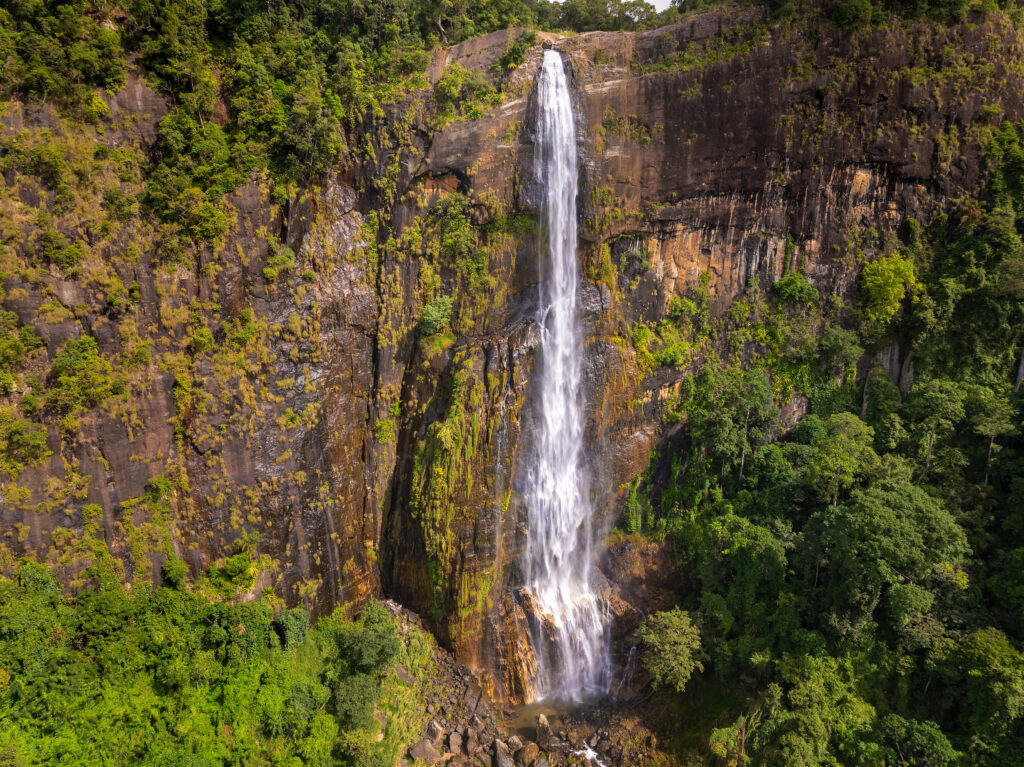
That upper section is what makes Diyaluma such an interesting day trip from Ella. You can hike to the top, walk between the pools and cascades, swim in some of them, and eventually reach viewpoints looking out across the valley from the edge of the falls.
I visited Diyaluma from Ella by car, stopped at the lower falls first and then continued to the trail for Upper Diyaluma. I did the hike without a guide, spent time swimming in the pools, and found the whole trip much easier to organise than I had expected.
In this guide, I’ll break down the route, the hike, the best places to swim, and the practical details I wish I’d known before going.
The practical details from my visit
Koslanda, Sri Lanka
About 220 metres
About 30 minutes
Easy in my experience
Free when I visited
350 LKR per person when I visited
I visited without one
Yes, in the upper pools
Ella
Half a day
Where Is Diyaluma Falls?
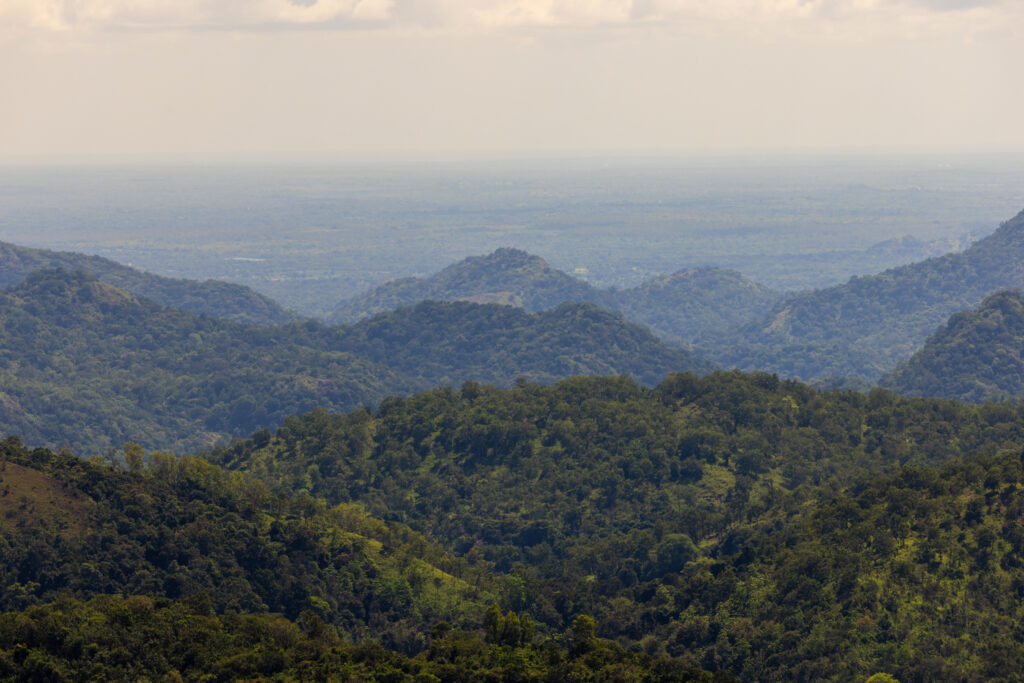

Diyaluma Falls is in the Badulla District of Sri Lanka, near the small town of Koslanda and around 40 km from Ella. It is one of the tallest waterfalls in the country, dropping roughly 220 metres from the plateau above into the valley below.
What can be slightly confusing when planning a visit is that Lower Diyaluma and Upper Diyaluma are two very different experiences. The lower falls are the enormous waterfall you see from the road, while Upper Diyaluma is reached from above, where a short hike leads through the forest to a series of cascades, natural pools and eventually the top of that same 220-metre drop.

If you’re staying in Ella, Diyaluma works very well as a half-day trip, although I’d leave enough time that you don’t have to rush the upper falls. The drive itself also takes you through some beautiful hill-country scenery, and there are a few worthwhile stops along the way.
Staying in Ella? I’ve put everything else I loved around town — from Little Adam’s Peak and Nine Arches Bridge to waterfalls, viewpoints and quieter places — in my complete Ella travel guide.
Upper Diyaluma vs Lower Diyaluma Falls
One thing that confused me slightly before visiting Diyaluma was the distinction between Lower Diyaluma and Upper Diyaluma. They aren’t two separate waterfalls. They are essentially two completely different ways of experiencing the same one.
Lower Diyaluma is where you see the waterfall from below. It’s the classic view: the entire column of water dropping down the enormous cliff, and it’s the best place to appreciate just how tall Diyaluma actually is. You can reach it directly from the road, so there’s no real hike involved.
Upper Diyaluma is a completely different experience. Instead of looking at the waterfall, you’re walking along the river that eventually becomes it. A short hike leads through the landscape above the falls to a series of smaller cascades and natural pools, some deep enough to swim in, before the water eventually reaches the edge of the plateau and disappears into the valley below.

That’s why, if you have the time, I’d visit both. Lower Diyaluma gives you the scale. Upper Diyaluma gives you the experience.
And doing them in that order made the most sense to me: first standing below and looking up at the waterfall, then driving around to the upper trail and eventually reaching the water I’d been watching fall from the cliff not long before.


See the waterfall from below
👀 Best for: seeing the full scale of Diyaluma
🚗 Access: directly from the road
🥾 Hiking: none needed
📷 Highlight: the entire 220-metre waterfall
⏱️ Time: works well as a short stop
Hike, swim & reach the top
💦 Best for: pools, cascades and the full experience
🥾 Access: around a 30-minute walk
⛰️ Difficulty: easy in my experience
🏊 Highlight: swimming in the natural pools
⏱️ Time: allow at least 1–2 hours
How to Get to Diyaluma Falls from Ella
Diyaluma Falls is around 40 kilometres from Ella, and the drive usually takes about an hour and a half depending on traffic and road conditions.
I visited Diyaluma as a day trip from Ella, which makes a very convenient base for exploring this part of Sri Lanka. If you’re planning to spend a few days there, my Ella travel guide covers the places I visited around town and how I organised my time there.
I went by car with a driver, which made the day particularly easy because Lower Diyaluma and the starting point for the Upper Diyaluma hike are in different places. I could stop below the waterfall first, continue driving towards the trailhead, and then meet the driver again after the hike.
If you’re organising a car and driver from Ella, expect to negotiate the price depending on how long you want to stay. I paid around 15,000–18,000 LKR for the trip.
The important thing to know is that searching for “Diyaluma Falls” on Google Maps isn’t quite enough. There are essentially two different places you need to navigate to:
- Lower Diyaluma Falls — the viewpoint beside the main road, where you see the entire waterfall from below.
- Upper Diyaluma trailhead — the starting point for the hike to the pools and top of the waterfall.
They are connected by the waterfall, but not by a straightforward walking route for visitors, so don’t arrive at the lower falls expecting the trail to begin there.

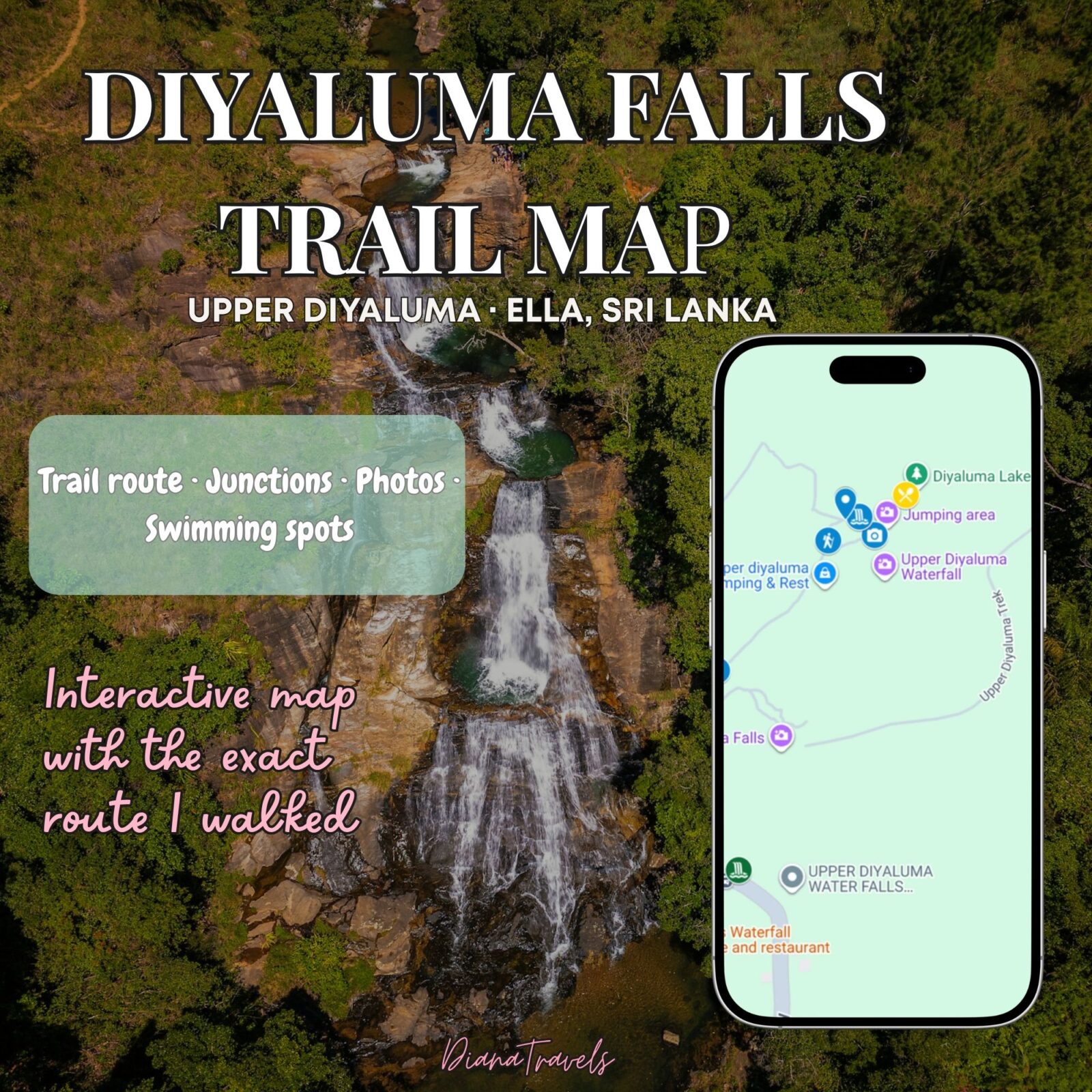
💡 Insider tip: The trail to Upper Diyaluma isn’t particularly difficult, but finding the correct starting point and knowing which way to go at a few places along the trail was less obvious. I’ve marked the exact route I walked, including the parking area, ticket point, useful landmarks and the turns where I wasn’t completely sure which way to go, on my detailed Diyaluma trail map.
Should You Visit Lower Diyaluma First?


Yes, I think you should.
It doesn’t take long, and seeing Diyaluma from below completely changes the experience of eventually standing at the top. From the roadside, the waterfall looks enormous. The water drops more than 200 metres down the dark cliff face, and from here you can actually see the scale that disappears once you’re standing above it.
I stopped here before heading to Upper Diyaluma, and I’m glad I did. A little later I would be swimming in the river that feeds this same waterfall, but from below it was difficult to imagine where those pools could possibly be.
You don’t need to spend a huge amount of time here. For me, it worked perfectly as the first stop of the day before continuing towards the Upper Diyaluma trailhead.
How to Get to Upper Diyaluma Falls
Getting to Upper Diyaluma Falls is the part that deserves the most explanation, because the trail itself was not difficult, but the start of the route and a few turns along the way were less obvious than I expected.
My driver dropped me at the parking area near the start of the Upper Diyaluma trail. From there, I walked past the ticket point and continued along the path towards the falls. The walk took me roughly 30 minutes at an easy pace.
The trail was not technically difficult when I visited. Most of it was straightforward walking rather than a proper mountain hike, although there were a few places where the path split and I had to stop for a moment to work out which direction to take. Those junctions were actually the main reason I later marked the route so carefully on my map.

After the parking area, the route gradually moves away from the road and into a quieter landscape. Depending on the exact conditions, parts of the trail can be uneven and exposed to sun, but I didn’t find anything particularly strenuous or technically challenging.

There is a ticket kiosk along the route, where I paid 350 LKR per person when I visited. After that, the trail continues towards the river and upper falls. Up until here, I found the general direction easy enough to follow, but afterwards there were still a few junctions where having a precise route would have saved me some second-guessing..

Eventually, the landscape begins to open up, and you reach the upper section of Diyaluma, where the river breaks into smaller cascades and pools. For me, the man selling fresh coconuts near the falls was also a very useful little landmark, and a pretty welcome sight after the walk.


Do you need a guide to find Upper Diyaluma?
I went without a guide and was completely comfortable doing so. The hike itself was easy in my experience, and I never felt that I needed someone to physically guide me along difficult terrain.
Navigation was the only part that occasionally made me pause. There were a few junctions where the correct direction wasn’t immediately obvious (and Google Maps was pointing me in the wrong direction), which is why having an offline map or precise route is useful.
If you’re comfortable following a trail and checking navigation as you go, I don’t think a guide is automatically necessary. If you’d rather not think about directions at all, are travelling alone and feel unsure, or conditions have changed because of rain, hiring a local guide can still make the visit simpler.
🗺️ Detailed Upper Diyaluma trail map

Hiking to Upper Diyaluma Falls
Calling it a hike almost makes it sound more demanding than I found it. The walk to Upper Diyaluma took me around 30 minutes, and there was nothing particularly difficult or technical about it when I visited. I’d describe it more as an easy walk along a rough trail than a serious hike.

Much of the route passes through open countryside and patches of vegetation, with views across the surrounding hills appearing along the way. The trail is uneven in places; there are some stairs early on, and there isn’t much shade on some sections, but I never found the walking itself strenuous.
What slowed me down more than the terrain was occasionally wondering whether I was still going the right way. Once I stopped worrying about navigation, though, it was a very easy and enjoyable walk.


As I got closer to Diyaluma, the landscape gradually changed. The river and small cascades begin to appear, and suddenly you’re no longer walking towards a huge waterfall. You’re walking beside the water that feeds it.
That was probably my favourite part of the approach.
After seeing Diyaluma as this enormous vertical drop from the road below, reaching the top feels strangely quiet. There isn’t one dramatic reveal. Instead, you arrive among rocks, flowing water and a series of pools scattered along the river, with the much bigger drop still hidden farther downstream.

And somewhere around here was one of my favourite little surprises of the day: a man selling fresh coconuts at the top. After walking through what had felt like fairly empty countryside, finding someone waiting beside the falls with cold coconuts was not something I’d expected.


From there, the trail gives way to the rocky upper section of Diyaluma, and this is where the experience becomes completely different.
You’re no longer hiking to the waterfall. You’re in it.

The Upper Diyaluma Pools
The upper section of Diyaluma was not quite what I had imagined while looking at the waterfall from below. Instead of arriving at one obvious viewpoint, I found a whole stretch of river broken up by smooth rock, small cascades and natural pools at different levels.
And that is really the reason I would come all the way up here rather than only stopping at Lower Diyaluma.

You can move between different parts of the river, finding places to sit on the rocks, smaller cascades and pools where the water collects before continuing downstream. Some sections felt almost completely separate from the enormous waterfall I’d seen earlier.
I also hadn’t expected it to feel quite so peaceful. There were other visitors around, but not many — fewer than ten around the places where I spent most of my time — so I never felt as though I was fighting for space beside the water.

The farther downstream you go, however, the more obvious it becomes where all that water is heading.
The landscape opens towards the valley, and the gentle sequence of pools and cascades eventually reaches the top of the main waterfall. From here, you’re looking out across the hills rather than up at Diyaluma, with the river disappearing over the cliff below you.
It’s a strange reversal after starting the day at the bottom.


I spent much longer up here than I did at Lower Diyaluma. There are enough different pools, rocks and little corners along the river that it doesn’t feel like somewhere you simply reach, take a photograph and leave.
And, inevitably, after looking at all that clear water for a while, I wanted to get in.
Can You Swim at Diyaluma Falls?
Yes, I swam at Upper Diyaluma, and it ended up being one of my favourite parts of the visit.

There are natural pools along the upper section of the river where people swim, and when I visited, the water in the pools I chose was calm enough that I felt comfortable getting in.
There was only one small problem. I had left my swimsuit in the car. 🫣
Going all the way back down wasn’t particularly appealing, and there was absolutely no chance I was coming all this way and not getting into those pools, so shorts and a top had to do.

I wouldn’t take my experience as a guarantee that the pools are always suitable for swimming, though. Diyaluma is a natural river system, and water levels, currents and conditions can change significantly, particularly after rain.
I also wouldn’t swim close to the main drop. The pools where I got into the water were away from the exposed edge, and I stayed in places where I was comfortable with the conditions.
So yes, bring a swimsuit, preferably remembering to take it out of the car 😅 but make the decision based on the conditions you actually find when you arrive.
Is Diyaluma Falls Dangerous?
Diyaluma didn’t feel dangerous to me while I was hiking or swimming in the upper pools, but there is one very obvious reason to treat the place with respect: eventually, all of that water goes over a 220-metre cliff.
There are no barriers separating you from the natural pools, slippery rocks, or the edge of the waterfall. Once you reach the lower part of Upper Diyaluma, it is possible to get surprisingly close to the main drop, and this isn’t somewhere I’d take unnecessary risks for a photograph.
Conditions can also be very different from one visit to another. Rain higher in the hills can change the water level and strength of the current, while wet rocks around the pools can become extremely slippery. What felt calm and manageable during my visit might not look the same on another day.
When I swam, I chose pools away from the main drop, where the water appeared calm and I felt comfortable with the conditions. I wouldn’t swim near the edge, enter fast-moving water, or assume that a pool is safe simply because you’ve seen photographs of other travellers swimming there.


I’d also be especially cautious after heavy rain. If the water looks stronger than expected or you’re unsure about the conditions, there are still plenty of reasons to enjoy Upper Diyaluma without swimming.
💡 Insider tip: enjoy the pools, but don’t treat Diyaluma like a managed swimming spot. It’s a wild river ending in one of Sri Lanka’s tallest waterfalls.
Do You Need a Guide for Diyaluma Falls?
I visited Upper Diyaluma without a guide, and for me, that was completely fine.
The hike itself wasn’t difficult, and I didn’t encounter any section where I felt I needed a guide because of the terrain. The only thing that occasionally made me hesitate was navigation. There were a few junctions where I wasn’t immediately sure which trail to take.
If you’re comfortable walking independently and following a map, I don’t think hiring a guide is essential. Having the exact trail marked makes the experience considerably easier, which is one of the reasons I created my detailed route after doing the walk myself.

A guide can still make sense if you’re not confident navigating independently, you’re travelling alone and would feel more comfortable with someone local, or trail and weather conditions are different when you visit.
Personally, though, I wouldn’t hire a guide simply because the hike is supposedly difficult. That wasn’t my experience at all. And if you’re doing it independently, I’d make sure you have your navigation sorted before leaving the parking area, rather than relying on mobile signal once you’re already on the trail.
How Long Do You Need at Diyaluma Falls?
I would allow at least half a day for Diyaluma Falls if you’re visiting from Ella.
The hike to Upper Diyaluma itself took me only around 30 minutes each way, but that isn’t where most of my time went. Once I reached the upper falls, I wanted time to walk between the different pools, swim, take photographs, and simply sit beside the water without constantly checking the clock.
If you’re also stopping at Lower Diyaluma first, as I did, factor in time for that as well as the drive between the lower falls and the Upper Diyaluma trailhead.
You could certainly visit more quickly, but I don’t think Diyaluma is somewhere worth rushing. The upper pools were easily the best part of the day for me, and I’d leave at least 1–2 hours to enjoy them once you arrive.

Best Time to Visit Diyaluma Falls
I’d visit Diyaluma in the morning, especially if you’re travelling from Ella and want to see both the lower and upper falls.
Starting early gives you plenty of time for the drive, a stop at Lower Diyaluma, and the hike to the upper pools without having to rush. It also means doing more of the walk before the middle of the day, which is useful because parts of the trail are exposed to the sun.

Weather matters more than the exact hour, though. I wouldn’t choose a day with heavy rain, particularly because the whole experience revolves around walking beside and swimming in a natural river system. Rain can affect water levels and currents, while wet rock around the pools can become extremely slippery.
At the same time, Diyaluma is a waterfall, so the amount of water naturally changes throughout the year. After a very dry period, the falls may be less powerful; during wetter periods, they can be far more dramatic — but potentially less suitable for swimming.
If swimming is important to you, I’d prioritise stable, dry weather and calm-looking water over trying to visit when the waterfall is at its most powerful.

And regardless of season, I’d check the weather around Diyaluma before setting off and make the final decision about swimming once you actually see the conditions at the pools.
How Crowded Is Diyaluma Falls?
Diyaluma was much quieter than I expected.
There were other visitors around, but at the upper pools where I spent most of my time, I saw fewer than ten people. It never felt crowded, and I had plenty of space to sit by the water, swim and move between the different pools without constantly having people in the frame.
That doesn’t mean you’ll necessarily have the same experience. Crowd levels can change with the time of day, weekends, holidays and weather, and Diyaluma is well known enough that I wouldn’t call it a secret.
Still, compared with some of Sri Lanka’s more heavily visited attractions, my visit felt surprisingly relaxed.

If you want the best chance of a quieter visit, I’d still go earlier in the day and avoid weekends or major holidays if you can.
What to Bring to Diyaluma Falls
You don’t need much for Diyaluma, but because you’re combining a hike with swimming and spending time outdoors, there are a few things I’d definitely take with you.
Good walking shoes are useful for the trail and especially around the uneven rocks near the pools. I wouldn’t choose this as the day to wear slippery sandals just because you’re heading to a waterfall.
Bring plenty of water, particularly if you’re walking later in the morning, as parts of the route are exposed to the sun. Sunscreen and a hat are useful for the same reason.
And, obviously, bring a swimsuit. Preferably remember to take it out of the car.
I didn’t. 🫣
By the time I reached those clear pools, there was absolutely no chance I was walking all the way back just to get it, so I ended up swimming in my shorts and top instead. It worked perfectly well, but it’s probably not the packing advice you came here for.

I’d pack:
- Comfortable walking shoes with decent grip
- Swimsuit
- Light towel or quick-dry towel
- Water
- Sunscreen + hat
- Insect repellent
- Small amount of cash for tickets, coconuts and other small purchases
- Phone with the route available offline
- Dry bag or waterproof pouch if you’re carrying electronics near the pools
If you’re bringing a camera or drone, I’d also take a bag you’re comfortable carrying over uneven ground rather than anything bulky. I had my photography gear with me, and the aerial views of both Lower and Upper Diyaluma were absolutely worth carrying it.
🌿 One thing I wouldn’t bring
Too much stuff.
You’re going to want your hands free while moving over rocks around the upper pools, and anything you carry in has to come back out with you. A small daypack with the essentials is plenty.
Where to Eat Near Diyaluma Falls
After the hike, I stopped for food nearby rather than driving straight back to Ella, and it turned out to be one of those simple travel stops that ends up being unexpectedly memorable.
The restaurant wasn’t fancy, but the food was really good, the portions were generous, and the price was excellent. After walking, swimming, and spending hours around the falls, it was exactly what I wanted.

What I remember most, though, is that they also gave me a whole bunch of bananas. I hadn’t expected it at all, and somehow that tiny gesture became one of my favourite details from the day.
I’ve marked the restaurant on my detailed Diyaluma map as well, so if you’re following the same route, it’s an easy place to keep in mind for lunch after the hike.
Is Diyaluma Falls Worth Visiting?
For me, absolutely, and not simply because Diyaluma is one of Sri Lanka’s tallest waterfalls.
Seeing the full drop from Lower Diyaluma is impressive, but it was the upper falls that made the trip worth it for me. The easy hike, the quiet pools, swimming between the rocks, and eventually looking out across the valley from the top made it feel like much more than another waterfall stop.

I also liked that the day had several distinct parts to it. I started below the waterfall looking up at a 220-metre cliff, drove around to the other side, walked through the countryside, found a man selling coconuts at the top, swam in the river and eventually stood above the same waterfall I’d been looking at a few hours earlier.
If you’re staying in Ella and have half a day to spare, Diyaluma is one trip I wouldn’t hesitate to make.
And I’d visit it exactly the same way again: Lower Diyaluma first, then hike to Upper Diyaluma and leave enough time to actually enjoy the pools rather than treating the top as another viewpoint to tick off.
Diyaluma ended up being one of those places that was even better than I expected, not only because of the enormous waterfall, but because of the walk, the pools and the time spent up above it. If you’re still planning your route through the country, I’ve collected more of my favourites in my guide to the best places to visit in Sri Lanka.
Diyaluma Falls FAQ
Planning a trip to Diyaluma still comes with a few practical questions, especially around the hike, swimming and getting there from Ella. Here are the quick answers to the things I’d want to know before visiting.
How high is Diyaluma Falls?
Diyaluma Falls is roughly 220 metres high, making it one of the tallest waterfalls in Sri Lanka. You get the best sense of its full scale from Lower Diyaluma, where you can see the entire drop from below.
How far is Diyaluma Falls from Ella?
Diyaluma Falls is around 40 km from Ella. I visited by private car with a driver, stopping at Lower Diyaluma before continuing towards the trailhead for Upper Diyaluma.
How long is the hike to Upper Diyaluma Falls?
The walk took me approximately 30 minutes each way. I found the terrain relatively easy; navigation at a few junctions was more confusing than the hike itself.
Can you swim at Diyaluma Falls?
I swam in some of the natural pools at Upper Diyaluma, away from the main waterfall edge. Conditions can change with rainfall and water levels, so always judge the conditions you find on the day and avoid fast-moving water or exposed areas near the main drop.
Do you need a guide for Diyaluma Falls?
I visited without a guide and found the hike easy. There were, however, a few places where I wasn’t immediately sure which trail to take, so having reliable navigation is useful if you’re visiting independently.
How much is the entrance fee for Diyaluma Falls?
I paid 350 LKR per person at the ticket kiosk on the way to Upper Diyaluma Falls. I’d bring some cash with you, as this is a small ticket point along the trail rather than somewhere I’d rely on being able to pay by card.
Should I visit Upper or Lower Diyaluma Falls?
I’d visit both. Lower Diyaluma gives you the best view of the waterfall’s enormous scale, while Upper Diyaluma is where you can hike between the cascades, explore the natural pools and experience the top of the falls. I recommend visiting Lower Diyaluma first.
How much time do you need at Diyaluma Falls?
I’d allow at least half a day from Ella if you want to visit both Lower and Upper Diyaluma without rushing. Once you reach the upper falls, I’d leave at least 1–2 hours to explore the pools, swim and enjoy the area.


